
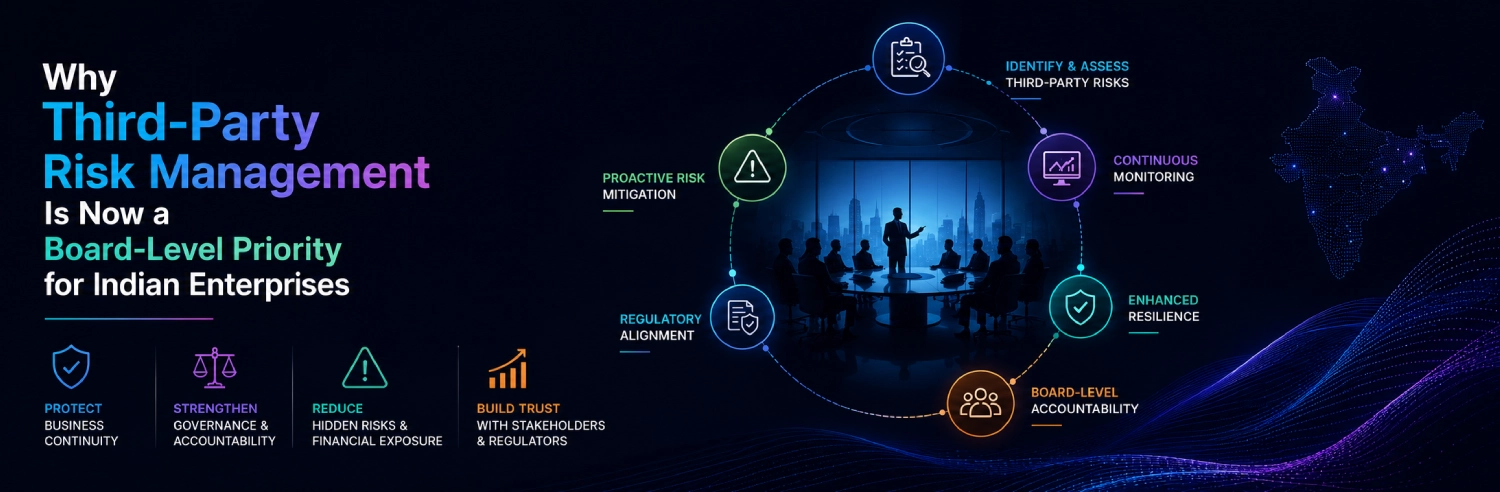
Why Third-Party Risk Management Is Now a Board-Level Priority for Indian Enterprises
For most Indian enterprises, the modern business runs on an extended network of vendors, SaaS platforms, cloud providers, payment processors, and outsourced partners. Each of those relationships expands what the organisation can do, and each one quietly expands its attack surface. When a vendor is breached, the consequences land on the enterprise that trusted them, the regulator that oversees them, and the customers whose data was exposed. That is precisely why third-party risk management has moved out of the procurement team’s spreadsheet and onto the boardroom agenda.
Across banking, insurance, healthcare, manufacturing, and technology, boards in India are now asking sharper questions: Who are our critical vendors? What data do they hold? How quickly would we know if they were compromised? In 2026, with stricter data protection rules, sector regulators tightening outsourcing expectations, and supply-chain attacks rising, third-party risk management (TPRM) is no longer an IT housekeeping task — it is a matter of corporate governance and fiduciary responsibility.
The Shift from Operational Risk to Governance Risk
Historically, vendor risk was treated as an operational concern, handled through one-time onboarding checklists and contractual indemnities. That model has broken down. A single compromised software supplier or managed service provider can cascade across hundreds of downstream organisations, as global supply-chain incidents have repeatedly shown. Boards have realised that they cannot outsource accountability even when they outsource the work.
Directors carry fiduciary duties to protect the enterprise from foreseeable harm. A serious breach traced back to a poorly governed vendor relationship now exposes the board to regulatory penalties, shareholder scrutiny, and reputational damage. This reframing — from operational risk to governance risk — is the core reason TPRM has earned a permanent seat at the board table.
Regulatory Pressure Is Converging on Vendor Oversight
India’s regulatory landscape has decisively raised the bar. The RBI’s outsourcing directions, the SEBI Cybersecurity and Cyber Resilience Framework (CSCRF)Cybersecurity and Cyber Resilience Framework (CSCRF), and IRDAI’s information and cybersecurity guidelines all require regulated entities to assess, contract with, and continuously monitor their service providers. The Digital Personal Data Protection (DPDP) regime adds a data-centric obligation: when a processor handles personal data on your behalf, you remain accountable for how it is protected.
The common thread is clear. Regulators expect documented due diligence, contractual security clauses, defined breach-notification timelines, and ongoing monitoring rather than a once-a-year tick-box exercise. Boards must be able to demonstrate that a structured, evidence-backed vendor risk programme exists and is actually working.
Why the Old Annual Assessment Model Fails
The traditional approach — a questionnaire sent during onboarding and perhaps revisited annually — assumes vendor risk is static. It is not. A vendor that was secure last quarter may have suffered a breach, lost a key certification, changed sub-processors, or let its security posture decay. Point-in-time assessments simply cannot capture this drift.
a) Risk changes continuously, but annual reviews only sample it once a year.
b) Questionnaires are self-reported, so they reflect intentions more than reality.
c) Fourth-party risk is invisible — your vendors’ vendors rarely appear in a standard assessment.
d) Critical vendors get the same cadence as low-risk ones, wasting effort and missing real exposure.
What a Board-Ready TPRM Programme Looks Like
A mature programme starts with a complete inventory of third parties, tiered by the criticality of the service and the sensitivity of the data they touch. High-risk vendors receive deeper due diligence, continuous monitoring, and tighter contractual controls, while low-risk vendors are handled proportionately. This risk-based tiering is what makes the programme both rigorous and scalable.
From there, the programme layers on standardised security assessments mapped to recognised frameworks, contractual clauses covering security, audit rights, and breach notification, and — crucially — continuous monitoring that flags changes in a vendor’s posture between formal reviews. Finally, it produces concise, board-level reporting so directors can see concentration risk, overdue assessments, and the organisation’s overall third-party risk exposure at a glance.
From Compliance Checkbox to Competitive Advantage
Enterprises that treat TPRM as strategic gain more than regulatory comfort. They onboard vendors faster because due diligence is systematised, they win enterprise customers who demand proof of supply-chain security, and they reduce the likelihood and cost of breaches. In an environment where customers and partners increasingly evaluate who they do business with based on security posture, a strong vendor risk programme becomes a differentiator rather than a cost centre.
Conclusion
Third-party risk has graduated from an operational nuisance to a core governance concern, and boards that ignore it do so at their peril. The enterprises pulling ahead are those that treat vendor oversight as a continuous, evidence-backed discipline rather than an annual formality.
By tiering vendors, standardising assessments, monitoring continuously, and reporting clearly to the board, Indian enterprises can satisfy regulators while genuinely reducing risk. The goal is simple: ensure that the partners who extend your capabilities never become the weakest link in your security.
Frequently Asked Questions
What is third-party risk management (TPRM)?
TPRM is the structured process of identifying, assessing, monitoring, and mitigating the cyber, compliance, and operational risks that vendors, suppliers, and partners introduce to your organisation. It spans onboarding due diligence, contractual safeguards, and continuous monitoring throughout the relationship, ensuring that outsourced services do not create unmanaged exposure.
Why is TPRM a board-level concern in India?
Directors carry fiduciary duties, and regulators including the RBI, SEBI, and IRDAI now expect documented vendor oversight. A breach traced to a poorly governed vendor exposes the board to penalties, shareholder scrutiny, and reputational harm. This makes TPRM a matter of corporate governance, not just IT administration.
How often should vendors be assessed?
Critical vendors should be monitored continuously rather than reviewed only once a year, with periodic deep assessments based on risk tier. Vendor risk is dynamic, so point-in-time questionnaires quickly become outdated. A risk-based mix of continuous monitoring and scheduled reassessment offers the strongest, most defensible coverage.
How Shieldbyte Infosec Can Help
Shieldbyte Infosec helps Indian enterprises operationalise third-party risk management end to end — from building a tiered vendor inventory and designing assessment workflows to continuous monitoring and board-level reporting. Our ShieldRisk platform uses AI to continuously identify, assess, monitor, and report cyber and compliance risks across vendors, suppliers, and partners, replacing static annual reviews with always-on visibility.
As a CERT-In empanelled security auditor with deep experience across BFSI, healthcare, and technology, Shieldbyte aligns your TPRM programme with RBI, SEBI, IRDAI, and DPDP expectations so your board can demonstrate genuine, evidence-backed oversight.