
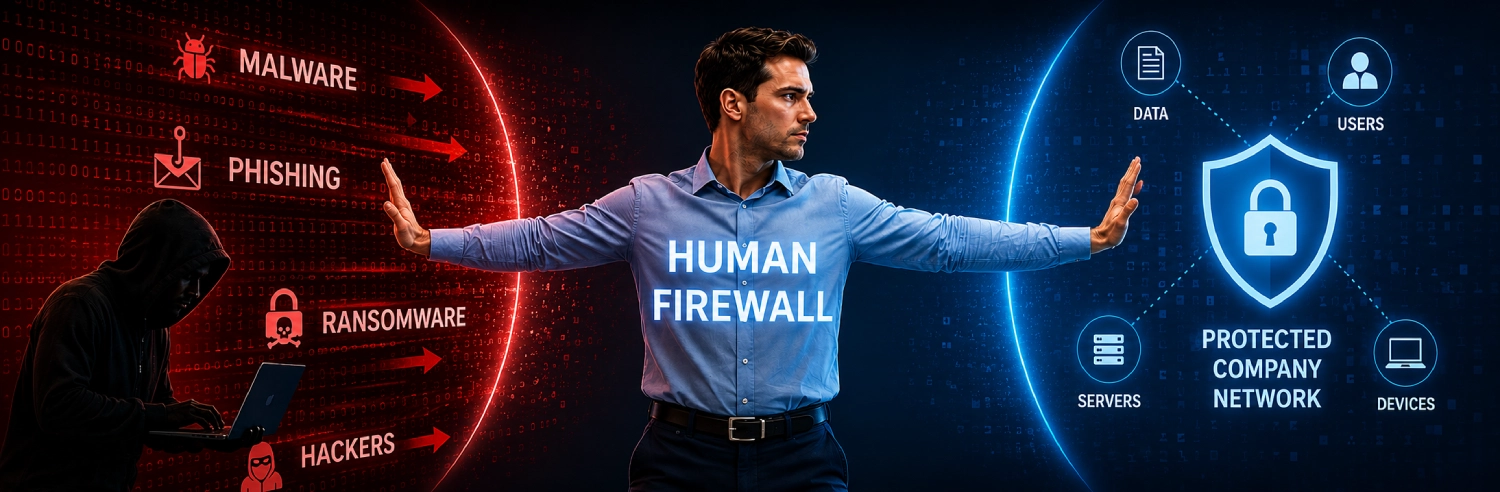
How Cybersecurity Awareness Training Builds a Strong Human Firewall
You can invest in the best firewalls, endpoint protection, and monitoring tools and still be breached by a single employee clicking a convincing phishing email. Year after year, industry breach reports show that the human element is involved in the overwhelming majority of incidents. Attackers know this, which is why social engineering remains their favourite entry point.
The good news is that the same people who are targeted can become your strongest line of defence. A well-designed cybersecurity awareness training programme transforms employees from the weakest link into a vigilant human firewall — one that recognises threats, hesitates before acting, and reports suspicious activity quickly.
Why Technology Alone Cannot Protect You
Security tools are essential, but they operate on rules and signatures. Attackers bypass them by targeting human judgement instead — crafting urgent emails, impersonating executives, and exploiting trust. A phishing email that lands in an inbox depends entirely on the recipient’s decision to click or report. No amount of technology removes that decision point.
This is why awareness is a control in its own right. When employees understand how attacks work and feel responsible for security, they close the gap that technology cannot reach. Awareness training is not a soft nice-to-have; it is a measurable risk-reduction investment.
What a Strong Awareness Programme Covers
Effective training goes well beyond an annual slideshow. It addresses the real situations employees face and the behaviours that keep the organisation safe:
1. Phishing, smishing, and vishing — recognising deceptive emails, SMS, and voice calls.
2. Password hygiene and MFA — strong, unique credentials and multi-factor authentication.
3. Safe data handling — classifying, storing, and sharing sensitive information correctly.
4. Social engineering — pretexting, impersonation, and manipulation tactics.
5. Remote and device security — safe use of home networks, personal devices, and public Wi-Fi.
6. Incident reporting — how and when to raise the alarm without fear of blame.
From One-Off Sessions to Continuous Learning
A single annual session is quickly forgotten. The most effective programmes use continuous reinforcement: short, frequent modules, simulated phishing exercises, contextual reminders, and role-specific content. Finance teams face different threats than developers or HR, and training should reflect that.
Simulated phishing is especially powerful because it converts abstract advice into lived experience. When an employee falls for a safe, simulated lure and receives immediate, supportive coaching, the lesson sticks far better than any lecture. Over time, measurable click rates fall and reporting rates rise.
Measuring the Human Firewall
What gets measured gets managed. Mature programmes track phishing simulation click and report rates, training completion, time-to-report, and trends across departments. These metrics reveal where risk concentrates and demonstrate progress to leadership and auditors alike.
Crucially, the goal is not to punish employees who fail but to identify where coaching is needed. A blame-free culture encourages people to report mistakes early — which is exactly the behaviour that limits the damage of a real attack.
Awareness as the Foundation of Security Culture
Training is the entry point to something larger: a genuine security culture where good practice is the norm, not the exception. When employees at every level understand their role in protecting the organisation, security stops being the IT team’s problem and becomes everyone’s responsibility. That cultural shift is the real return on investment.
It also supports compliance. Frameworks like ISO 27001 and regulatory expectations from RBI, SEBI, and DPDP explicitly require security awareness. A documented, continuous programme helps satisfy these obligations while genuinely reducing risk.
Conclusion
Technology can filter the obvious threats, but it is people who make the final decision to click, share, or report. A continuous, engaging awareness programme turns that decision point from a vulnerability into a defence.
When awareness is reinforced through simulation, measured honestly, and supported by a blame-free culture, employees become a genuine human firewall. That cultural shift is among the highest-return investments any organisation can make in its security.
Frequently Asked Questions
What is a human firewall?
A human firewall is a workforce trained to recognise, resist, and report cyber threats such as phishing and social engineering. Because most breaches involve human error, well-trained employees act as a critical layer of defence that technology alone cannot provide, catching attacks that slip past technical controls.
How often should security awareness training happen?
Awareness should be continuous rather than a single annual session. Short, frequent modules combined with regular phishing simulations reinforce learning and keep security top of mind. Role-specific content and ongoing reinforcement are far more effective at changing behaviour than a once-a-year presentation.
Does awareness training help with compliance?
Yes. Frameworks such as ISO 27001 and regulatory expectations from the RBI, SEBI, and the DPDP regime explicitly require security awareness. A documented, continuous programme with measurable results helps satisfy these obligations while genuinely reducing the likelihood of a successful attack.
How do you measure the effectiveness of awareness training?
Effective programmes track metrics such as phishing simulation click rates, report rates, time-to-report, training completion, and incident trends across departments. These indicators reveal where risk concentrates, demonstrate progress to leadership and auditors, and guide where additional coaching is needed, rather than being used to punish individuals who make mistakes.
How Shieldbyte Infosec Can Help
Shieldbyte Infosec delivers expert-led cybersecurity awareness training tailored to your workforce, combining engaging content with realistic phishing simulations. Our ShieldPhish platform lets you simulate real-world phishing across email, QR (quishing), and SMS (smishing), then turns the results into targeted coaching that measurably strengthens your human firewall.
We design programmes that map to ISO 27001, DPDP, and sector-specific requirements, so your awareness initiative satisfies auditors while changing behaviour where it counts.