
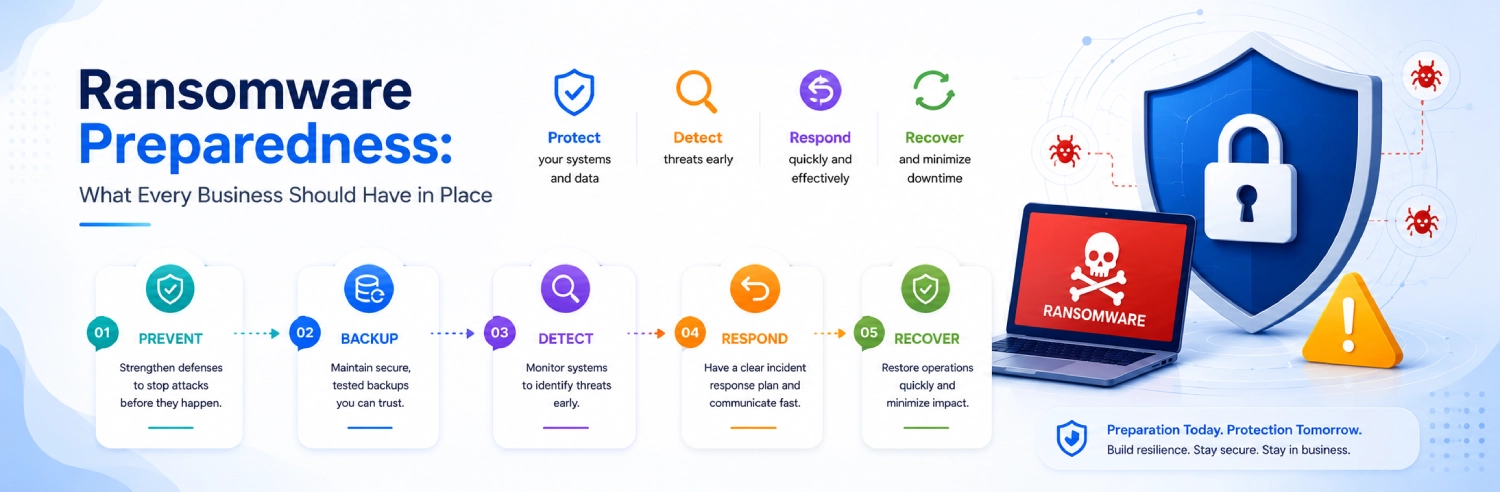
Ransomware Preparedness: What Every Business Should Have in Place
Ransomware has become one of the most damaging threats facing organisations of every size. A single successful attack can encrypt critical systems, halt operations, expose stolen data, and demand a ransom that pales beside the true cost of downtime and recovery. Attackers increasingly use double extortion — encrypting data and threatening to leak it — making prevention and preparation equally vital.
The reality is stark: it is no longer a question of if your organisation will be targeted, but when. Ransomware Preparedness is about ensuring that when an attack comes, you can prevent, detect, contain, and recover without paying — and without your business grinding to a halt. This checklist covers what every organisation should have in place.
Prevention: Closing the Doors Attackers Use
Most ransomware enters through a small set of well-worn routes — phishing, exposed remote access, and unpatched vulnerabilities. Hardening these dramatically reduces your risk. Prevention is always cheaper than recovery, and the foundational controls are well understood:
1. Multi-factor authentication on email, VPN, and remote access.
2. Timely patching of operating systems, applications, and internet-facing services.
3. Email and endpoint protection to block malicious attachments and payloads.
4. Least-privilege access so a compromised account cannot reach everything.
5. Network segmentation to limit how far an intrusion can spread.
6. Phishing awareness training to stop the most common entry point.
Backups: Your Last Line of Defence
When prevention fails, reliable backups are what let you recover without paying a ransom. But attackers now deliberately target backups, so they must be designed to survive an attack. The widely cited principle is to keep multiple copies, on different media, with at least one copy offline or immutable and off-site.
Equally important is testing restoration regularly. A backup you have never restored is a hope, not a plan. Organisations that routinely verify they can recover key systems within a defined timeframe are the ones that walk away from ransomware demands.
Detection and Rapid Response
Speed determines the scale of damage. The faster you detect unusual activity — mass file changes, suspicious logins, disabled security tools — the more you can contain before encryption spreads. This requires monitoring, logging, and alerting tuned to ransomware behaviour, ideally with 24×7 coverage or a managed detection arrangement.
Detection must connect to a tested incident response plan that defines who does what, how to isolate affected systems, how to communicate, and how to engage external help. In India, remember that CERT-In requires reporting specified incidents within six hours, so reporting steps must be built into the plan.
Incident Response and Recovery Planning
A ransomware-specific incident response plan turns chaos into a controlled process. It should cover isolation and containment, forensic preservation, decision-making around the attack, regulatory and customer notification, and a clear recovery sequence prioritising the most critical systems.
Crucially, the plan must be rehearsed. Tabletop exercises and drills reveal gaps — unclear roles, missing contacts, untested restores — while the stakes are low. Organisations that practise respond calmly and recover faster when a real attack hits.
Building Long-Term Resilience
Ransomware preparedness is not a one-time setup but an ongoing posture. Threats evolve, infrastructure changes, and complacency creeps in. Sustained resilience comes from regular vulnerability assessments and penetration testing, continuous awareness training, periodic plan testing, and keeping backups and recovery procedures current.
Framed this way, preparedness pays off even if you are never hit: the same controls that defeat ransomware strengthen your security and compliance posture across the board, supporting frameworks like ISO 27001 and regulatory expectations.
Conclusion
Ransomware is no longer a question of if but when, and preparedness is what separates a contained incident from a business-ending one. Strong prevention, resilient backups, fast detection, and a rehearsed response plan together let you recover without paying.
Because the same controls that defeat ransomware strengthen your overall security and compliance posture, preparedness pays off even if you are never hit. Treat it as an ongoing posture, not a one-time setup, and revisit it as threats evolve.
Frequently Asked Questions
How can we protect against ransomware?
Layer prevention, backups, detection, and response. Enforce multi-factor authentication, patch promptly, deploy email and endpoint protection, apply least privilege and network segmentation, and train staff against phishing. Maintain immutable, offline backups and a tested incident response plan so you can recover without paying a ransom.
What is the 3-2-1 backup rule?
The 3-2-1 principle recommends keeping at least three copies of your data, on two different types of media, with at least one copy stored offline or immutable and off-site. Because attackers now target backups, immutability and offline copies are essential, and restoration should be tested regularly.
Should we pay the ransom?
Authorities generally advise against paying, as it funds criminal activity and offers no guarantee of recovery or that stolen data will not be leaked. The reliable alternative is preparedness: tested backups, a rehearsed response plan, and rapid detection that together let you recover on your own terms.
How Shieldbyte Infosec Can Help
Shieldbyte Infosec helps organisations build genuine ransomware resilience — assessing your exposure through VAPT and attack surface analysis, hardening prevention controls, validating backup and recovery readiness, and developing and testing incident response plans aligned with CERT-In reporting obligations.
Through awareness training with ShieldPhish, vulnerability management, and vCISO support, we help you prevent attacks where possible and recover confidently when they occur.