
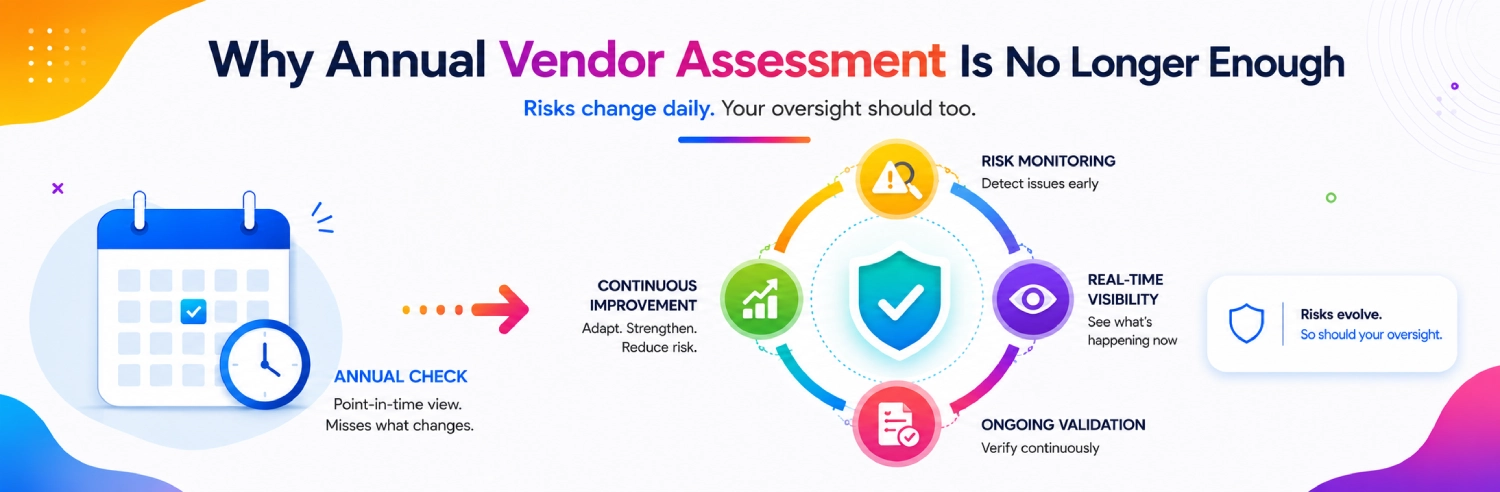
Why Annual Vendor Assessment Is No Longer Enough
For years, the standard approach to vendor risk was simple: send a questionnaire when onboarding a supplier, file the responses, and repeat the exercise once a year. It felt thorough, it satisfied auditors, and it was manageable. But the threat landscape has outgrown this model entirely. In a world where a vendor can be breached, change ownership, or quietly let its security lapse between reviews, an annual snapshot is dangerously out of date the moment it is filed.
The uncomfortable truth is that point-in-time vendor assessments create a false sense of security. They tell you how a vendor looked on one day, not how they look today. This article explains why the annual model fails and what continuous third-party risk monitoring looks like in practice.
Risk Is Dynamic, Assessments Are Static
A vendor’s risk profile changes constantly. They onboard new sub-processors, deploy new systems, suffer breaches, lose certifications, cut security budgets, or get acquired. None of these events wait for your annual review cycle. By the time your next questionnaire goes out, the picture you captured last year may bear little resemblance to reality.
This mismatch between dynamic risk and static assessment is the fundamental flaw. You can be fully ‘compliant’ with an annual process while remaining completely blind to a vendor that was compromised six months ago.
The Hidden Weaknesses of Questionnaires
Beyond timing, the traditional questionnaire has structural problems that limit how much assurance it can really provide:
1. Self-reported — answers reflect what vendors say, not independently verified reality.
2. Point-in-time — accurate only on the day completed, and immediately ageing.
3. Surface-level — rarely reach fourth parties (your vendors’ vendors).
4. Inconsistent — different formats make comparison and trend analysis hard.
5. Resource-heavy — chasing responses consumes time that could fund real monitoring.
What Continuous Monitoring Adds
Continuous monitoring closes the gap between assessments by keeping a live view of each vendor’s security posture. Instead of waiting twelve months, you receive ongoing signals — external security ratings, exposure of credentials, certificate changes, breach disclosures, and changes in the vendor’s footprint — and you are alerted when something material changes.
This shifts vendor risk from a periodic audit to an always-on capability. Combined with periodic deep assessments for your most critical vendors, continuous monitoring ensures you learn about deterioration in days, not at the next anniversary. It is the difference between a smoke detector and an annual fire inspection.
Prioritising Where Continuous Attention Matters
Not every vendor warrants the same intensity. The practical path is to tier your vendors by criticality and data sensitivity, then apply continuous monitoring most rigorously to those that could cause the greatest harm. A cloud provider holding customer data deserves constant attention; a low-risk supplier may need far less.
This risk-based approach keeps the programme both effective and sustainable. You focus scarce attention where exposure is highest, while still maintaining baseline oversight across the whole ecosystem — and you can prove that prioritisation to regulators and auditors.
Making the Shift Practical
Moving from annual to continuous does not mean abandoning assessments; it means layering live monitoring on top of them and automating the heavy lifting. Modern TPRM platforms ingest external risk signals, track vendor posture over time, and surface alerts and trends so your team acts on real changes rather than chasing paperwork.
The payoff is significant: earlier warning of vendor problems, faster onboarding, lower breach likelihood, and effortless evidence for regulators who increasingly expect ongoing oversight rather than annual snapshots.
Conclusion
Annual vendor assessments create a false sense of security because they capture a single moment while risk changes continuously. A vendor that passed last year’s review may be exposed today, and you would never know.
Continuous monitoring closes that gap, alerting you to deterioration in days rather than at the next anniversary. Layered on top of risk-based deep assessments, it delivers earlier warning, faster onboarding, and the ongoing oversight regulators increasingly expect.
Frequently Asked Questions
Why isn't an annual vendor assessment enough?
Vendor risk is dynamic. Between annual reviews, a vendor can suffer a breach, change sub-processors, lose certifications, or let security lapse. A once-a-year questionnaire is outdated almost immediately and is self-reported, so it reflects intentions more than verified reality. Continuous monitoring fills this gap.
What is continuous vendor monitoring?
Continuous monitoring keeps a live view of each vendor's security posture using ongoing external signals such as security ratings, exposed credentials, certificate changes, and breach disclosures. It alerts you when something material changes, turning vendor risk from a periodic audit into an always-on capability.
Should every vendor be monitored continuously?
Not equally. Tier vendors by criticality and data sensitivity, then apply the most rigorous continuous monitoring to those that could cause the greatest harm. This risk-based approach keeps the programme effective and sustainable while maintaining baseline oversight across the whole ecosystem.
How Shieldbyte Infosec Can Help
Shieldbyte Infosec helps organisations move from outdated annual reviews to continuous third-party risk management. Our ShieldRisk platform uses AI to continuously identify, assess, monitor, and report cyber and compliance risks across your vendors — alerting you when a vendor’s posture changes instead of waiting for the next cycle.
We help you tier your vendor ecosystem, design the right blend of deep assessments and continuous monitoring, and produce the board- and regulator-ready reporting that modern oversight demands.