
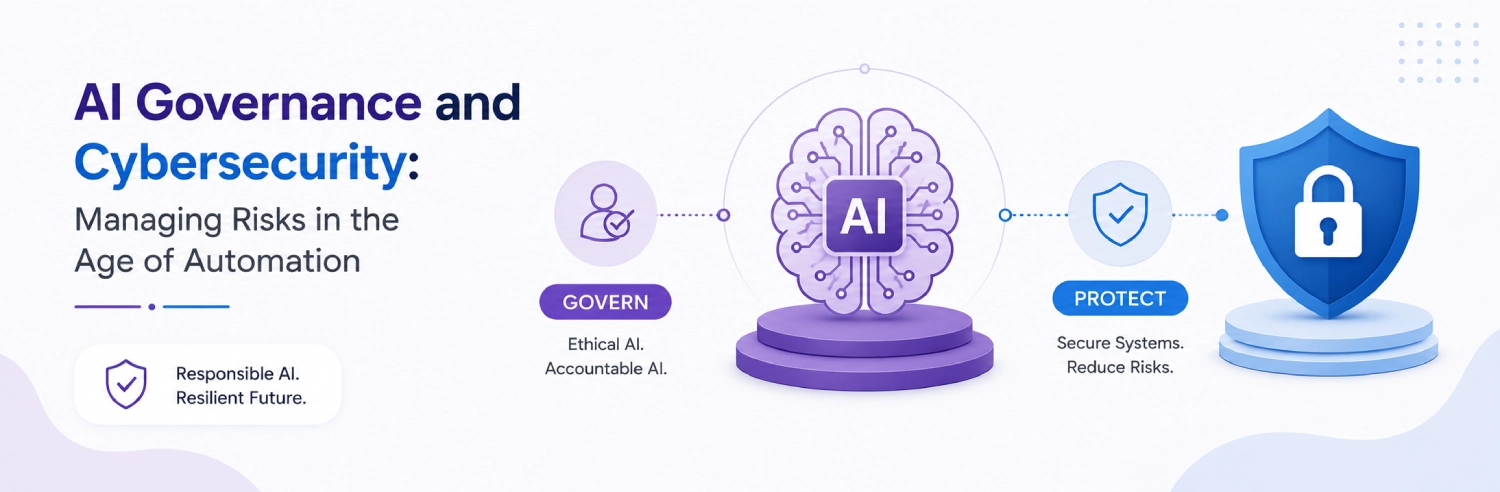
AI Governance and Cybersecurity: Managing Risks in the Age of Automation
Artificial intelligence has moved from experiment to infrastructure. Organisations now embed AI into customer service, fraud detection, software development, hiring, and decision-making. Each deployment brings efficiency — and a new class of risk that traditional security programmes were never designed to handle. Managing AI responsibly has become a core part of cybersecurity and corporate governance.
AI systems can leak sensitive data, be manipulated through adversarial inputs, produce biased or opaque decisions, and expand the attack surface in ways that are hard to see. Treating AI as just another IT tool is a mistake; it demands dedicated governance that sits alongside, and integrates with, your cybersecurity programme. This article explains how to approach it.
The New Risks AI Introduces
AI changes the risk picture in several distinct ways. Models trained on sensitive data can inadvertently memorise and expose it. Generative tools can be tricked through prompt injection or jailbreaks into bypassing safeguards. And the rush to adopt AI often means shadow AI — employees feeding confidential data into public tools without oversight.
There are also risks unique to AI’s nature: decisions that cannot be easily explained, biases baked into training data, and dependence on third-party models whose behaviour and security you do not control. These are not hypothetical; they are live concerns for any organisation deploying AI at scale.
Why AI Governance Needs Its Own Discipline
Cybersecurity protects systems from attackers; AI governance ensures AI is used responsibly, securely, and in line with legal and ethical expectations. The two overlap heavily but are not identical. Governance asks not only ‘Is this system secure?’ but also ‘Is it fair, explainable, accountable, and used within agreed boundaries?’
This is why dedicated frameworks have emerged. ISO/IEC 42001, the first management-system standard for AI, gives organisations a structured way to govern AI responsibly, while the NIST AI Risk Management Framework offers practical guidance for identifying and managing AI risks. Together they help operationalise responsible AI.
Building an AI Governance Programme
A practical AI governance programme rests on visibility, policy, and control. You cannot govern what you cannot see, so the foundation is an inventory of where and how AI is used across the business. From there, the essential building blocks include:
1. An AI use inventory covering internal models, third-party tools, and shadow AI.
2. Clear acceptable-use policies for employees and developers.
3. Data governance controlling what data feeds models and how outputs are used.
4. Risk assessment for each AI use case, proportionate to its impact.
5. Human oversight for high-stakes or automated decisions.
6. Vendor due diligence on the security and trustworthiness of AI providers.
Securing AI Systems Technically
Governance must be backed by technical security. AI systems should be tested against adversarial attacks, prompt injection, and data-poisoning attempts, just as applications are penetration-tested. Access to models and training data must be controlled, monitored, and logged, and outputs should be validated rather than blindly trusted.
Because many AI capabilities come from third parties, supply-chain assurance matters too. Understanding how an AI vendor secures data, what it does with prompts, and how it handles incidents is now a standard part of vendor risk management.
Turning Responsible AI into Trust
Organisations that govern AI well do not just avoid harm — they earn trust. Customers, regulators, and partners increasingly want assurance that AI is used safely and ethically. Demonstrating structured AI governance, ideally aligned to recognised standards, becomes a competitive advantage as AI regulation matures worldwide.
In short, AI governance and cybersecurity are two sides of the same coin. Build them together, and automation becomes a source of durable advantage rather than unmanaged risk.
Conclusion
AI delivers real efficiency, but it also introduces risks that traditional security programmes were never designed to handle. Managing it well requires dedicated governance that sits alongside, and integrates with, your cybersecurity efforts.
Organisations that combine AI governance with technical security and frameworks like ISO 42001 and the NIST AI RMF can innovate confidently. Done right, responsible AI is not just risk management; it becomes a source of trust and competitive advantage.
Frequently Asked Questions
What are the main cybersecurity risks of AI?
Key risks include data leakage from models trained on sensitive information, manipulation through prompt injection or adversarial inputs, biased or opaque decisions, and shadow AI where employees feed confidential data into public tools. Dependence on third-party models whose security you do not control adds further exposure.
What is ISO 42001?
ISO/IEC 42001 is the first international management-system standard for artificial intelligence. It gives organisations a structured, auditable framework for governing AI responsibly, covering risk management, accountability, transparency, and oversight. It complements ISO 27001 and helps operationalise responsible AI alongside existing security management.
How do we govern AI use across the business?
Start with an inventory of where and how AI is used, including third-party tools and shadow AI. Then add acceptable-use policies, data governance, risk assessment for each use case, human oversight of high-stakes decisions, and vendor due diligence on AI providers, ideally aligned to a recognised framework.
How Shieldbyte Infosec Can Help
Shieldbyte Infosec helps organisations adopt AI safely by combining cybersecurity expertise with structured AI governance. We support ISO/IEC 42001 AI management system implementation, build AI use inventories and policies, assess AI-specific risks, and test AI systems for security weaknesses.
By integrating AI governance with your existing ISO 27001 ISMS and vendor risk programme, we help you innovate with AI while keeping data, decisions, and reputation protected.