
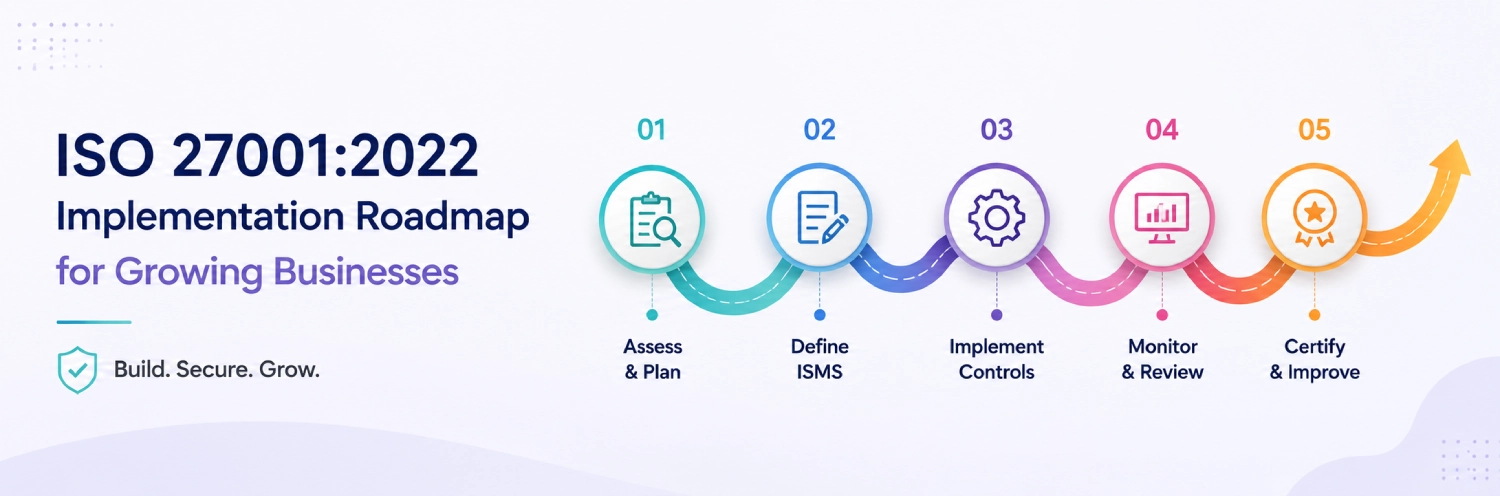
ISO 27001:2022 Implementation Roadmap for Growing Businesses
ISO/IEC 27001 is the world’s most recognised standard for information security management, and the 2022 revision is now the only version organisations can certify against — the older 2013 version’s certificates expired in October 2025. For growing businesses, achieving ISO 27001:2022 certification signals to customers, partners, and regulators that information security is managed systematically rather than ad hoc.
But certification is not a product you buy; it is the outcome of building a working Information Security Management System (ISMS). The good news is that the path is well-defined, and a growing business can navigate it with the right roadmap and discipline. This guide walks through the journey stage by stage.
Step 1: Secure Leadership Support and Define Scope
Every successful ISMS starts with genuine leadership commitment. Top management must sponsor the initiative, allocate resources, and set the information security policy. Without this, the programme stalls. With it, the rest of the journey becomes far smoother.
Next, define the scope: which parts of the business, locations, systems, and data the ISMS will cover. A clear, realistic scope keeps the effort manageable and aligns certification with what your customers actually care about. Scoping too broadly early on is a common cause of delay.
Step 2: Run a Risk Assessment
Risk assessment is the engine of ISO 27001. You identify information assets, the threats and vulnerabilities they face, and the potential impact of compromise. From there you evaluate and prioritise risks, then decide how to treat each one — mitigate, transfer, accept, or avoid.
The 2022 revision reorganises Annex A into four themes — organisational, people, physical, and technological controls — and introduces several new controls reflecting modern realities such as threat intelligence, cloud security, and data masking. Your risk treatment plan maps the controls you will implement to the risks you have identified.
Step 3: Implement Controls and Documentation
With your risk treatment plan in hand, you implement the necessary controls and produce the documentation the standard requires. This is where policies become practice. Typical deliverables include:
1. Statement of Applicability (SoA) justifying which supplier security, and more.
3. Operational procedures for incident management, change, and business continuity.
4. Awareness training so staff understand their responsibilities.
5. Records and evidence demonstrating the ISMS is operating.
Step 4: Internal Audit and Management Review
Before inviting an external certification body, you must test the ISMS yourself. An internal audit checks whether controls are implemented and effective and surfaces non-conformities to fix. A management review then confirms that leadership is engaged, objectives are being met, and the ISMS remains suitable.
These steps are not bureaucratic box-ticking — they are how you find and fix problems on your own terms, before a certification auditor does. Organisations that take internal audit seriously sail through certification far more smoothly.
Step 5: Certification and Continual Improvement
Certification happens in two stages: a Stage 1 documentation review and a Stage 2 assessment of how the ISMS operates in practice. On success, you receive your ISO 27001:2022 certificate, typically valid for three years with annual surveillance audits.
Certification is the milestone, not the finish line. ISO 27001 is built on continual improvement: you keep monitoring risks, addressing findings, and adapting controls as your business and the threat landscape evolve. A living ISMS protects you long after the certificate is framed on the wall.
Conclusion
ISO 27001:2022 certification demonstrates that information security is managed systematically, and with the 2013 version retired, the 2022 standard is now the only path. The journey from scoping and risk assessment to certification is well-defined and achievable for businesses of any size.
The key is to treat the ISMS as a living system rather than a one-off project. Organisations that embed continual improvement sail through surveillance audits and keep reaping security benefits long after the certificate is issued.
Frequently Asked Questions
Is ISO 27001:2013 still valid?
No. The three-year transition period ended on 31 October 2025, and ISO 27001:2013 certificates expired or were withdrawn after that date. Organisations must now certify against ISO 27001:2022, which reorganises Annex A into four control themes and introduces several new controls reflecting modern risks.
How long does ISO 27001 implementation take?
For most growing businesses, implementation takes several months to a year, depending on scope, maturity, and resources. The timeline covers scoping, risk assessment, control implementation, documentation, internal audit, and the two-stage certification assessment. A focused scope and leadership support significantly accelerate the process.
What are Annex A controls?
Annex A lists the reference security controls organisations can apply to treat identified risks. The 2022 revision groups them into four themes: organisational, people, physical, and technological. Your Statement of Applicability documents which controls apply and why, based on your risk assessment.
How Shieldbyte Infosec Can Help
Shieldbyte Infosec guides growing businesses through ISO 27001:2022 from gap assessment to certification and beyond. We help scope your ISMS, run pragmatic risk assessments, draft right-sized documentation, implement Annex A controls, and prepare you for internal and certification audits — without drowning your team in paperwork.
We also provide ISO awareness and lead-implementer training so your people can sustain the ISMS, and we align it with related standards like ISO 27701 and SOC 2 to maximise the value of your effort.