
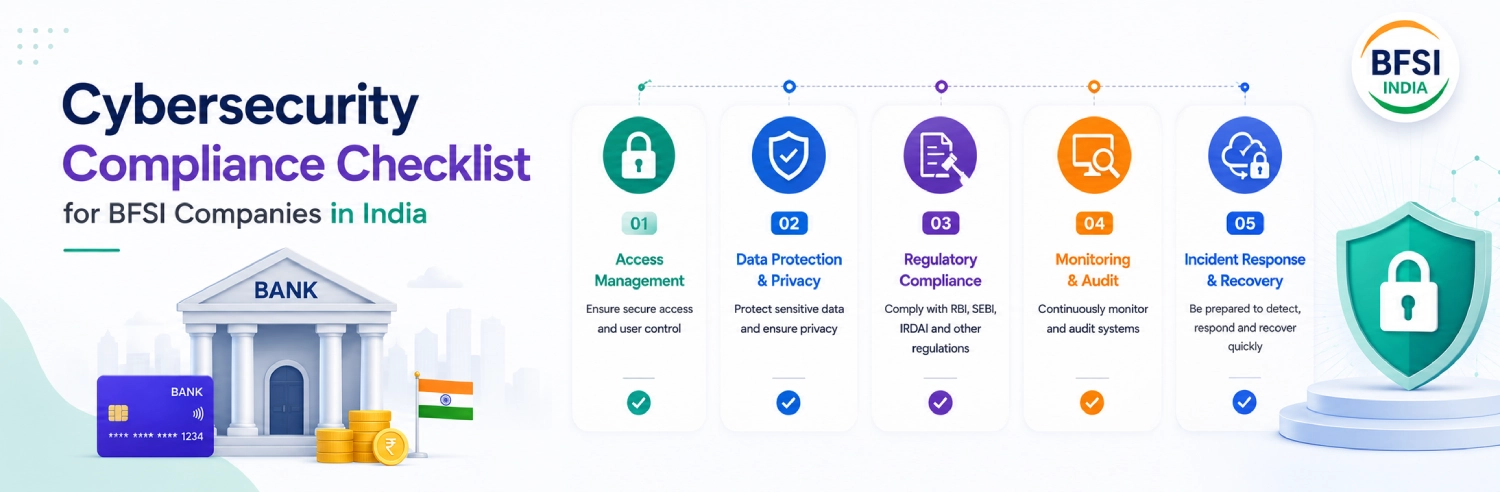
Cybersecurity Compliance Checklist for BFSI Companies in India
The banking, financial services, and insurance (BFSI) sector is the most heavily regulated — and most heavily targeted — part of India’s economy. It holds vast amounts of money and sensitive personal data, which makes it a magnet for cyber criminals and a priority for regulators. For BFSI companies, cybersecurity compliance is not a once-a-year audit exercise; it is a continuous obligation spanning multiple overlapping frameworks.
Between RBI directions, the SEBI CSCRF, IRDAI guidelines, CERT-In directions, and the emerging DPDP regime, the requirements can feel overwhelming. This checklist distils the essentials into a practical, sector-wide view so BFSI leaders can see where they stand and where to focus. Use it as a starting framework, then tailor it to your specific regulator and risk profile.
Governance and Risk Management
Regulators consistently expect cybersecurity to be owned at the top. The foundation of compliance is a governance structure where the board and senior management are accountable, supported by clear policies and a risk-based approach:
1. Board-approved cybersecurity policy reviewed and updated regularly.
2. Defined roles including a CISO or equivalent with appropriate authority.
3. Risk assessment identifying, rating, and treating cyber risks.
4. Cyber crisis management plan with tested escalation paths.
Technical Security Controls
Strong governance must be backed by robust technical defences. Regulators look for layered controls across the environment that protect data, detect intrusions, and limit damage:
1. Access control and MFA with least-privilege principles.
2. Network security including segmentation, firewalls, and intrusion detection.
3. Encryption of sensitive data in transit and at rest.
4. Endpoint and email security against malware and phishing.
5. Patch and vulnerability management with regular VAPT.
6. Logging and monitoring, with logs retained as required.
Incident Detection, Response, and CERT-In Reporting
CERT-In’s directions require entities to report specified cyber incidents within six hours of detection and to maintain ICT system logs for 180 days, stored within India. BFSI companies must therefore have the ability to detect incidents quickly and report them within tight timelines.
This means a documented incident response plan, a 24×7 monitoring capability or arrangement, defined breach-notification procedures for regulators and customers, and regular testing of the plan through drills. The six-hour clock starts at awareness, so detection and escalation speed are critical.
Third-Party and Outsourcing Oversight
BFSI organisations rely heavily on vendors, and every regulator now expects rigorous third-party oversight. Your programme should include due diligence before onboarding, security and audit clauses in contracts, certification expectations for critical providers, and continuous monitoring of vendor posture.
Concentration risk — over-dependence on a single provider — must be actively managed, and exit strategies should be defined so a vendor failure does not become a business failure. Increasingly, continuous monitoring rather than annual review is the expectation.
Data Protection, Audit, and Continuous Readiness
With the DPDP regime advancing, BFSI firms must map personal data, implement consent and data-principal-rights processes, and protect customer information throughout its lifecycle. Sector-specific audits — RBI IS audits, SEBI cyber audits, ISNP audits for insurers — must be completed by qualified, often CERT-In empanelled, auditors.
The most resilient organisations treat compliance as continuous rather than episodic. They maintain evidence year-round, run periodic internal assessments, and remediate gaps proactively so that each regulatory examination is a confirmation rather than a crisis.
Conclusion
BFSI organisations face an intense, overlapping web of cybersecurity obligations spanning RBI, SEBI, IRDAI, CERT-In, and the DPDP regime. A structured checklist helps leaders see where they stand and prioritise the gaps that matter most.
The most resilient firms treat compliance as continuous rather than episodic, maintaining evidence year-round and remediating proactively. Approached this way, each regulatory examination becomes a confirmation of readiness rather than a stressful scramble.
Frequently Asked Questions
Which regulations apply to BFSI companies in India?
Depending on the sub-sector, BFSI firms must address RBI directions, the SEBI Cybersecurity and Cyber Resilience Framework, IRDAI guidelines, CERT-In directions, and the DPDP regime. Many controls overlap, so a unified programme mapped across frameworks is more efficient than addressing each in isolation.
What is the CERT-In 6-hour reporting rule?
CERT-In requires entities to report specified categories of cyber incidents within six hours of noticing them or being made aware. The clock is tied to awareness rather than completing an investigation, so BFSI firms need monitoring and escalation processes capable of recognising and reporting incidents quickly.
Do BFSI audits require a CERT-In empanelled auditor?
Many Indian regulatory and tender requirements specify that security audits be conducted by CERT-In empanelled auditors. Engaging an empanelled auditor provides recognised assurance that systems have been assessed to the expected standard, which is frequently required across the BFSI sector.
How does DPDP affect BFSI companies?
BFSI firms handle large volumes of sensitive personal and financial data, making DPDP obligations significant. They must map personal data, implement consent and data-principal-rights processes, apply retention limits, secure information throughout its lifecycle, and ensure vendors that process data on their behalf are bound by appropriate contracts and safeguards.
How Shieldbyte Infosec Can Help
Shieldbyte Infosec is a CERT-In empanelled security auditor with deep BFSI expertise across banks, NBFCs, brokers, payment companies, and insurers. We help you assess your posture against RBI, SEBI CSCRF, IRDAI, CERT-In, and DPDP requirements, remediate gaps, and complete the mandated audits.
From VAPT and incident-response readiness to vendor risk management with ShieldRisk and awareness training with ShieldPhish, we provide the full stack BFSI compliance demands — backed by managed services that keep you continuously audit-ready.