
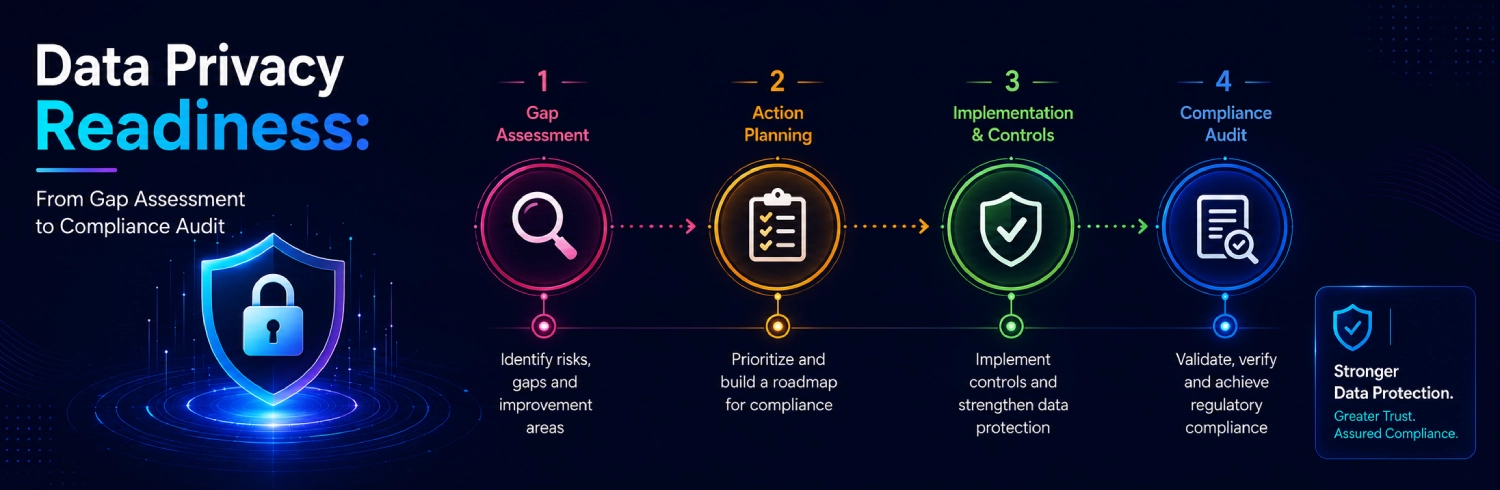
Data Privacy Readiness: From Gap Assessment to Compliance Audit
Data privacy has shifted from a legal afterthought to a board-level concern. With India’s DPDP regime advancing and global laws like GDPR setting expectations for any company serving international customers, organisations must be able to prove — not just claim — that they protect personal data responsibly. Getting there is a journey, and like any journey, it helps to know the route.
That route runs from understanding where you stand today, through fixing what is missing, to demonstrating compliance through audit. Privacy readiness is not a single project but a structured progression from gap assessment to remediation to audit and ongoing assurance. This article maps that progression.
Step 1: The Privacy Gap Assessment
Every privacy programme should start with an honest assessment of the current state against the laws and standards that apply to you — DPDP, GDPR, sector rules, and frameworks like ISO 27701. A gap assessment examines your policies, processes, systems, and contracts to identify where you fall short and what risk that exposes you to.
The output is a clear picture: what you already do well, where the gaps are, and how serious each one is. This becomes the basis for a prioritised remediation plan, ensuring effort goes where it reduces the most risk rather than being spread thinly.
Step 2: Data Discovery and Mapping
You cannot protect personal data you cannot locate. A core readiness activity is discovering and mapping what personal data you collect, where it is stored, how it flows through your systems, who can access it, and which third parties receive it.
This data inventory underpins nearly every privacy obligation — from honouring data-principal rights and applying retention limits to assessing vendor risk and responding to breaches. Many organisations are surprised by how much data they hold and how widely it travels, which is precisely why mapping is foundational.
Step 3: Remediation and Control Implementation
With gaps identified and data mapped, the remediation phase closes the distance to compliance. Typical workstreams address the practical mechanisms regulators and auditors expect to see in operation:
1. Notices and consent redesigned to be clear, granular, and withdrawable.
2. Data-principal rights processes for access, correction, and erasure.
3. Retention and minimisation schedules to hold only what is needed.
4. Vendor contracts updated with data-processing and security terms.
5. Security safeguards to prevent and detect personal data breaches.
6. Governance including, where required, a Data Protection Officer.
Step 4: The Compliance Audit
Once controls are in place and operating, an audit verifies that your privacy programme actually works as intended. Depending on your context, this may be an internal audit, a readiness review ahead of certification, or a formal assessment against a standard such as ISO 27701.
A successful audit produces evidence you can show customers, partners, and regulators. It also identifies residual issues to address, keeping the programme honest. Crucially, audit is not the end — it is a checkpoint that confirms readiness and sets the bar for ongoing assurance.
Step 5: Sustaining Readiness
Privacy readiness erodes if left alone. New systems, vendors, products, and regulations constantly change the picture. Mature organisations maintain readiness through periodic reassessment, continuous monitoring of data flows and vendors, refreshed training, and prompt updates as laws evolve.
Treated this way, privacy becomes a durable capability rather than a scramble before each audit. The payoff is twofold: lower regulatory risk and a genuine trust advantage with customers who increasingly choose partners that protect their data.
Conclusion
Privacy readiness is a structured journey, not a single project. It runs from an honest gap assessment, through data mapping and remediation, to audit and ongoing assurance.
Organisations that follow this path can prove, not just claim, that they protect personal data responsibly. The payoff is twofold: lower regulatory risk and a genuine trust advantage with customers who increasingly choose partners that safeguard their data.
Frequently Asked Questions
What is a privacy gap assessment?
A privacy gap assessment evaluates your current policies, processes, systems, and contracts against the laws and standards that apply to you, such as DPDP, GDPR, and ISO 27701. It identifies where you fall short and how serious each gap is, forming the basis for a prioritised remediation plan.
Why is data mapping important for privacy compliance?
You cannot protect personal data you cannot locate. Data discovery and mapping reveal what personal data you collect, where it is stored, how it flows, who can access it, and which third parties receive it. This inventory underpins nearly every privacy obligation, from honouring rights to breach response.
How do we prove privacy compliance?
Through audit. Once controls are implemented and operating, an internal audit, readiness review, or formal assessment against a standard such as ISO 27701 verifies the programme works. A successful audit produces evidence you can show customers, partners, and regulators, and sets the bar for ongoing assurance.
How Shieldbyte Infosec Can Help
Shieldbyte Infosec takes organisations through the full privacy readiness journey — gap assessment against DPDP, GDPR, and ISO 27701, data discovery and mapping, remediation of policies, consent and contracts, and audit-readiness assurance.
Our Data Protection Officer services and privacy training help you sustain readiness over time, while our auditors provide the independent verification customers and regulators expect.