
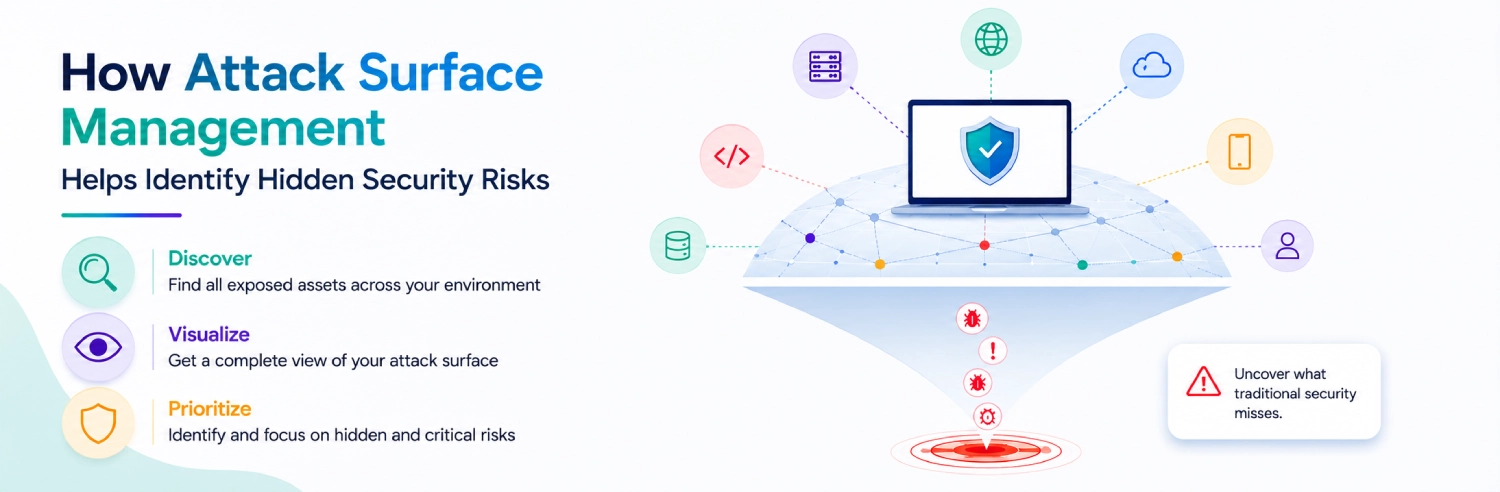
How Attack Surface Management Helps Identify Hidden Security Risks
You cannot protect what you do not know exists. Yet most organisations have a surprising amount of digital infrastructure they have lost track of — forgotten subdomains, test servers left online, exposed cloud storage, third-party tools signed up for by individual teams, and assets inherited through acquisitions. Attackers actively hunt for exactly these blind spots, because unknown assets are unmonitored and unpatched.
Attack Surface Management (ASM) is the discipline of continuously discovering, inventorying, and assessing everything in your organisation that is exposed to the internet. It answers a deceptively hard question — what do we actually have facing the outside world? — and turns that answer into a prioritised list of risks to fix before attackers find them.
Why the Attack Surface Keeps Growing
Modern organisations expand their digital footprint constantly. Cloud adoption, SaaS sprawl, remote work, APIs, microservices, and rapid development all create new internet-facing assets — often faster than security teams can track. Mergers and acquisitions add entire unfamiliar estates overnight.
The result is that the real attack surface is almost always larger than the official inventory. Each forgotten or unmanaged asset is a potential entry point, and because no one is watching it, a vulnerability there can sit exploitable for months.
What Attack Surface Management Does
ASM continuously maps your external footprint from an attacker’s perspective and flags where you are exposed. Rather than a one-off scan, it provides ongoing discovery and assessment across the assets that matter:
1. Asset discovery — domains, subdomains, IPs, cloud instances, and services you may not know about.
2. Shadow IT detection — unsanctioned tools and infrastructure spun up outside IT.
3. Exposure identification — open ports, misconfigurations, expired certificates, and exposed data.
4. Vulnerability context — which exposed assets carry known, exploitable weaknesses.
5. Continuous monitoring — alerting as new assets appear or risks emerge.
The Hidden Risks ASM Surfaces
ASM regularly uncovers issues that traditional, inventory-based scanning misses entirely. Common findings include forgotten development and staging environments still reachable from the internet, exposed databases or storage buckets, outdated systems running unpatched software, and misconfigured services leaking information.
It also reveals risks introduced by third parties and acquisitions — assets your team never provisioned but that now belong to you. Because attackers treat your whole footprint as fair game, surfacing these unknowns is often the single highest-value security activity an organisation can undertake.
From Discovery to Prioritised Action
Discovery alone is not enough; the value of ASM lies in turning findings into prioritised remediation. Effective programmes rank exposures by exploitability and business impact, so teams fix the most dangerous issues first rather than drowning in a flat list of alerts.
This risk-based prioritisation is what makes ASM actionable. Combined with vulnerability assessment and penetration testing, it creates a closed loop: discover what is exposed, understand how badly, fix what matters most, and verify the fix — continuously.
ASM as a Continuous Discipline
Because your attack surface changes daily, ASM cannot be a quarterly project. It works best as a continuous capability that runs in the background, flagging new exposures as they appear and feeding them into your security operations. The organisations least likely to be blindsided are those that always know what they have facing the internet.
Integrated with broader risk management, ASM also strengthens third-party oversight — the same external visibility that maps your footprint can illuminate your vendors’ exposure too, tying attack surface insight directly into vendor risk decisions.
Conclusion
You cannot defend assets you do not know you have, and modern organisations accumulate unknown internet-facing infrastructure faster than they can track it. Attack surface management brings that hidden footprint into view from an attacker’s perspective.
By continuously discovering exposed assets, surfacing risks, and prioritising remediation by impact, ASM closes the blind spots that traditional inventory-based scanning misses. As a continuous discipline tied into vulnerability management and vendor risk, it is one of the highest-value security investments available.
Frequently Asked Questions
What is attack surface management (ASM)?
ASM is the continuous discovery, inventory, and assessment of everything an organisation exposes to the internet. It maps your external footprint the way an attacker would, surfacing unknown assets, misconfigurations, and vulnerabilities so they can be remediated before they are exploited.
How is ASM different from a vulnerability scan?
Traditional scans assess assets you already know about. ASM starts a step earlier by discovering assets you may not know exist, including shadow IT, forgotten environments, and infrastructure inherited through acquisitions. It then assesses them, giving a far more complete picture of real-world exposure.
Why does the attack surface keep growing?
Cloud adoption, SaaS sprawl, remote work, APIs, rapid development, and mergers all create new internet-facing assets, often faster than security teams can track. Each forgotten or unmanaged asset is a potential entry point, which is why continuous discovery is essential.
How does ASM support vendor risk management?
The same external visibility that maps your own footprint can also illuminate your vendors' exposure. By assessing what attackers can see of a vendor's internet-facing systems, ASM provides objective evidence of their real security posture, feeding directly into vendor risk decisions rather than relying on self-reported questionnaires alone.
How Shieldbyte Infosec Can Help
Shieldbyte Infosec helps organisations gain control of their external attack surface through continuous discovery, exposure assessment, and prioritised remediation guidance. We combine attack surface visibility with vulnerability assessment and penetration testing to give you a complete, actionable picture of your real-world exposure.
Our ShieldRisk platform extends this visibility to your vendor ecosystem, so you can see and manage both your own exposure and that of the third parties you depend on.