
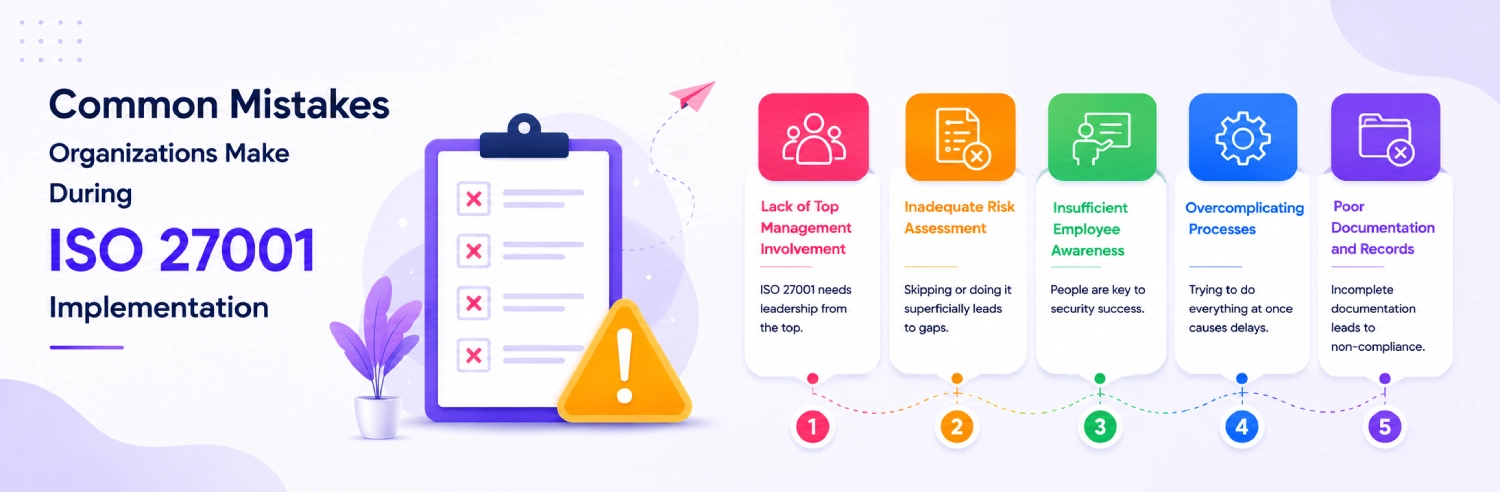
Common Mistakes Organizations Make During ISO 27001 Implementation
ISO 27001 certification is achievable for organisations of any size, yet many implementations run over budget, miss deadlines, or stumble at the certification audit. The standard itself is not the problem — the way it is approached usually is. The same avoidable mistakes appear again and again, draining time and goodwill before the ISMS ever delivers value.
Knowing these pitfalls in advance is the single best way to sidestep them. Most ISO 27001 failures are not technical; they are failures of scope, ownership, and treating the standard as paperwork rather than practice. Here are the most common mistakes and how to avoid each one.
Mistake 1: Treating It as an IT-Only Project
ISO 27001 is frequently handed to the IT team as a technical task. In reality, information security spans HR, legal, procurement, operations, and leadership. When the ISMS is built in an IT silo, it misses critical risks and fails to embed across the business, leaving auditors unconvinced that security is truly managed.
The fix is to position ISO 27001 as a business initiative with visible leadership sponsorship and cross-functional involvement. Top-management commitment is not just an audit requirement — it is what makes the whole programme stick.
Mistake 2: Getting the Scope Wrong
Scope errors cut both ways. Scope too broadly and the project becomes unmanageable, with controls and evidence required across systems that customers do not even care about. Scope too narrowly and the certificate is meaningless to the stakeholders you are trying to reassure.
The right approach is a deliberate, risk-aligned scope that covers what matters to your customers and your risk profile, defined clearly at the outset. A well-chosen scope keeps the effort proportionate and the certificate credible.
Mistake 3: Copy-Paste Policies and Risk Assessments
Templates have their place, but lifting generic policies and a boilerplate risk assessment wholesale is a recurring failure. Auditors quickly spot documentation that does not reflect how the organisation actually operates, and staff ignore policies that bear no relation to their work.
Documentation should be right-sized and real — tailored to your context, owned by the relevant teams, and genuinely followed. A lean set of accurate policies beats a thick binder of aspirational ones every time.
Mistake 4: Underestimating Risk Assessment and Evidence
Risk assessment is the heart of ISO 27001, yet it is often rushed or treated as a formality. A weak risk assessment leads to controls that do not match real threats and a Statement of Applicability that cannot be defended. Equally common is failing to generate and retain the evidence that proves controls are operating.
Avoid this by investing in a thorough, repeatable risk assessment and by building evidence collection into day-to-day operations from the start, rather than scrambling to assemble it days before the audit.
Mistake 5: Stopping at Certification
Perhaps the most damaging mistake is treating certification as the finish line. ISO 27001 is built on continual improvement, with surveillance audits and a living risk picture. Organisations that disband the project team and let the ISMS go dormant often struggle at the first surveillance audit and lose the security benefits entirely.
Sustained value comes from embedding the ISMS into normal operations — ongoing risk reviews, internal audits, awareness, and improvement. Common avoidable mistakes, summarised, include:
1. Treating ISO 27001 as an IT-only project rather than a business one.
2. Scoping too broadly or too narrowly.
3. Using copy-paste policies disconnected from reality.
4. Rushing the risk assessment and neglecting evidence.
5. Stopping all effort once the certificate is issued.
Conclusion
Most ISO 27001 failures stem not from technical difficulty but from avoidable mistakes: treating it as an IT-only project, mis-scoping, copy-paste documentation, rushed risk assessment, and stopping at certification.
Knowing these pitfalls in advance is the best way to sidestep them. Approach the standard as a business initiative with genuine ownership, right-sized documentation, and continual improvement, and certification becomes a milestone on a sustainable journey rather than a painful one-off.
Frequently Asked Questions
What is the most common ISO 27001 mistake?
Treating ISO 27001 as an IT-only project is among the most common and damaging mistakes. Information security spans HR, legal, procurement, operations, and leadership. When the ISMS is built in an IT silo, it misses critical risks and fails to embed across the business, leaving auditors unconvinced.
Can we use policy templates for ISO 27001?
Templates can be a useful starting point, but lifting generic policies and a boilerplate risk assessment wholesale is a recurring failure. Auditors quickly spot documentation that does not reflect reality, and staff ignore irrelevant policies. Documentation should be right-sized, tailored, owned, and genuinely followed.
What happens after ISO 27001 certification?
Certification is typically valid for three years with annual surveillance audits. ISO 27001 is built on continual improvement, so you must keep monitoring risks, addressing findings, and adapting controls. Organisations that let the ISMS go dormant often struggle at the first surveillance audit and lose the security benefits.
How Shieldbyte Infosec Can Help
Shieldbyte Infosec helps organisations implement ISO 27001:2022 the right way — with proper scoping, pragmatic risk assessment, right-sized documentation, and an ISMS that staff actually use. We help you avoid the common pitfalls that derail timelines and certification.
Beyond certification, we support internal audits, awareness training, and continual improvement so your ISMS keeps delivering value and sails through surveillance audits year after year.