
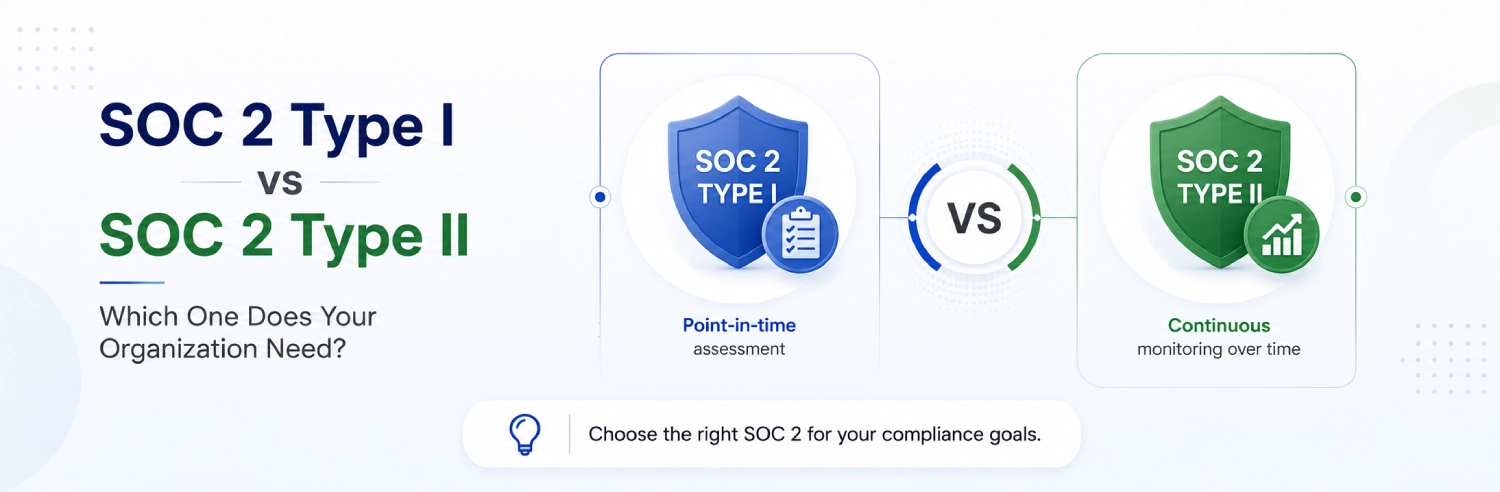
SOC 2 Type I vs SOC 2 Type II: Which One Does Your Organization Need?
If your organisation handles customer data — especially as a SaaS provider, cloud company, or service organisation — sooner or later a prospect or partner will ask for your SOC 2 report. SOC 2 has become the de facto trust signal for technology vendors, and increasingly Indian companies serving global clients are expected to produce one. But a common question stalls many teams at the starting line: do you need SOC 2 Type I or Type II?
The two are related but answer different questions, take different amounts of time, and carry different weight with customers. Choosing the right one — at the right stage of your journey — saves time, budget, and credibility. This guide explains the difference and helps you decide.
What SOC 2 Actually Measures
SOC 2 is an attestation framework developed by the AICPA that evaluates how a service organisation protects customer data against five Trust Services Criteria: Security, Availability, Processing Integrity, Confidentiality, and Privacy. Security is mandatory; the others are included based on the commitments you make to customers. An independent auditor examines your controls and issues a report that customers can rely on.
Unlike a certification, SOC 2 produces a detailed report describing your controls and the auditor’s findings. That report is what your customers’ security teams review during vendor due diligence — which is exactly why the Type I versus Type II distinction matters.
SOC 2 Type I: A Point-in-Time Snapshot
A SOC 2 Type I report assesses whether your controls are suitably designed and in place at a specific point in time. It answers the question: ‘Do you have the right controls defined and implemented today?’ Because it does not test how the controls operate over a period, a Type I can be completed relatively quickly.
Type I is well suited to organisations that need to demonstrate progress fast — for example, to unblock a sales deal or reassure a new partner — and that intend to follow up with a Type II. It establishes that your control framework exists and is sound, providing an honest starting point.
SOC 2 Type II: Proven Over Time
A SOC 2 Type II report goes further. It assesses whether your controls are not only well designed but also operating effectively over a defined observation period — typically three to twelve months. The auditor gathers evidence across that window to confirm controls work consistently, not just on the day of the audit.
Because it demonstrates sustained operation, Type II carries significantly more weight with customers and is the report most enterprise buyers ultimately want to see. It is more demanding and takes longer, but it is the stronger, more credible assurance of your security posture.
Key Differences at a Glance
Both reports use the same Trust Services Criteria, but they differ in scope, effort, and the confidence they give a customer:
1. Timing — Type I is a snapshot in time; Type II covers a period (often 3–12 months).
2. What’s tested — Type I tests control design; Type II tests design and operating effectiveness.
3. Effort and duration — Type I is faster; Type II requires sustained evidence collection.
4. Customer confidence — Type II is more rigorous and more widely demanded by enterprises.
5. Best use — Type I to move fast and establish a baseline; Type II for mature, ongoing assurance.
Which One Should You Choose?
If you are early in your compliance journey and need to show customers that solid controls exist, a Type I is a sensible first step — followed by a Type II once controls have been operating for the required period. If you already have mature, consistently operating controls and your customers expect strong assurance, you may go straight to Type II.
The most common path is sequential: achieve Type I to validate design and unblock immediate needs, then pursue Type II to prove effectiveness over time. Whichever route you take, a readiness assessment first will surface control gaps before the formal audit, saving rework and cost.
Conclusion
SOC 2 has become a baseline trust signal for service organisations, and choosing between Type I and Type II is really a question of where you are on your journey. Type I validates that strong controls exist; Type II proves they work consistently over time.
The most common and credible path is sequential: achieve Type I to establish a baseline and unblock immediate needs, then pursue Type II for the sustained assurance enterprise customers ultimately expect. A readiness assessment first will surface gaps before the formal audit.
Frequently Asked Questions
What is the main difference between SOC 2 Type I and Type II?
Type I assesses whether your controls are suitably designed and in place at a single point in time. Type II goes further, testing whether those controls operate effectively over a period of typically three to twelve months. Type II is more rigorous and carries more weight with customers.
Which SOC 2 report do customers prefer?
Most enterprise customers ultimately want a Type II report because it demonstrates that controls operate consistently over time, not just on the day of the audit. A Type I can satisfy immediate needs and unblock deals, but it is usually a stepping stone toward Type II.
How long does SOC 2 take?
A Type I can be completed relatively quickly once controls are in place, often within a few weeks of readiness. A Type II requires an observation period, commonly three to twelve months, during which the auditor gathers evidence that controls operate effectively before issuing the report.
How Shieldbyte Infosec Can Help
Shieldbyte Infosec supports organisations through the entire SOC 2 lifecycle — scoping the right Trust Services Criteria, running a readiness and gap assessment, remediating control weaknesses, and preparing you for both Type I and Type II examinations. We help you choose the path that matches your business goals and customer expectations.
Our consultants align your SOC 2 effort with related frameworks such as ISO 27001, so you build one strong control environment that serves multiple compliance needs rather than duplicating effort.