
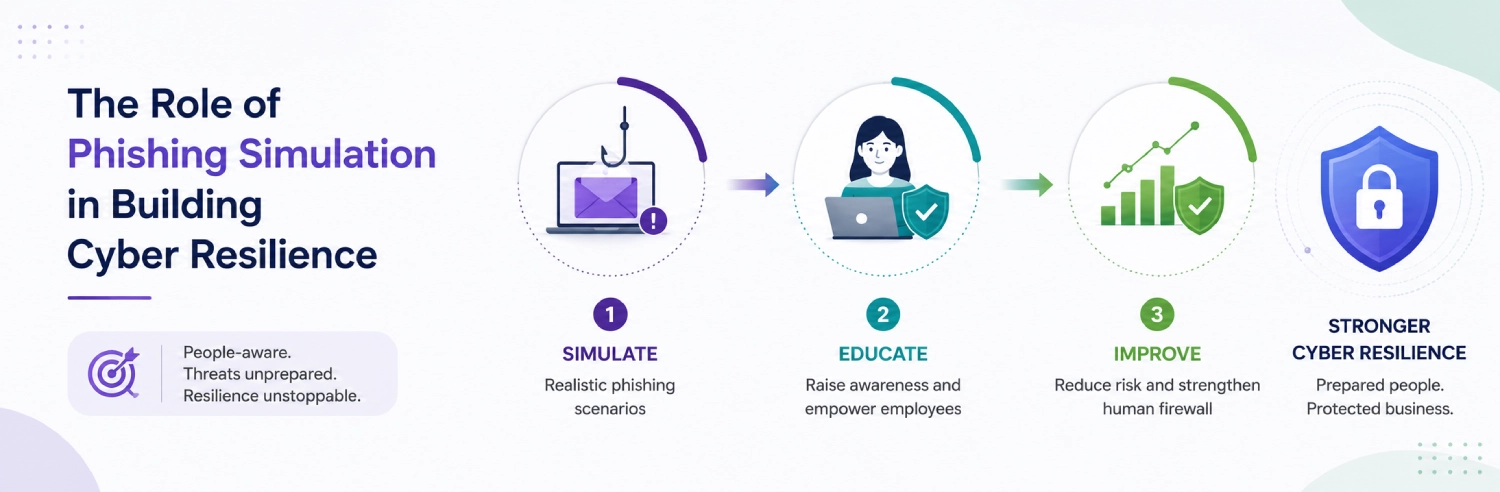
The Role of Phishing Simulation in Building Cyber Resilience
Phishing remains the most common way attackers break into organisations. It is cheap to run, hard to fully block with technology, and devastatingly effective because it targets human behaviour. Defenders cannot stop attackers from sending phishing emails — but they can train their people to recognise and resist them. That is exactly what phishing simulation does.
A phishing simulation programme safely mimics real-world attacks, measures how employees respond, and turns every interaction into a coaching opportunity. Done well, it converts your workforce from a soft target into an active early-warning system — a cornerstone of genuine cyber resilience.
Why Simulation Beats Lectures
Traditional security training tells people what to do; phishing simulation shows them what happens when they don’t. When an employee clicks a realistic but harmless simulated lure and immediately receives gentle, specific feedback, the lesson is experiential and memorable. Abstract warnings fade; a moment of ‘I nearly fell for that’ sticks.
This experiential learning is why simulation consistently outperforms one-off awareness sessions at changing behaviour. Repeated, varied exposure builds instinctive caution — employees start to pause, hover over links, and question urgency, which is precisely the reflex that stops real attacks.
Modern Phishing Goes Beyond Email
Attackers have expanded their channels, and simulations must keep pace. Effective programmes test employees across the same vectors criminals actually use:
1. Email phishing — the classic deceptive message with malicious links or attachments.
2. Quishing (QR phishing) — malicious QR codes that redirect to credential-harvesting sites.
3. Smishing (SMS phishing) — fraudulent text messages exploiting trust in mobile.
4. Vishing-style pretexts — scenarios that mirror voice and callback scams.
5. Business email compromise — executive impersonation and payment-fraud lures.
Designing an Effective Programme
Effective simulation is continuous and varied, not a single annual test. Campaigns should rotate difficulty and themes, target relevant scenarios for different roles, and gradually raise the challenge as employees improve. Crucially, the tone must be supportive: the aim is to build skills, not to shame people who fall for a lure.
Immediate, in-the-moment training at the point of failure is the most valuable feature. When someone clicks, a short, friendly explanation of the red flags they missed turns a mistake into durable learning. Over successive campaigns, this steadily reduces susceptibility across the organisation.
Measuring Resilience Over Time
Phishing simulation produces hard metrics that demonstrate progress and direct effort. Tracking click rates, report rates, and time-to-report over successive campaigns shows whether resilience is genuinely improving and where pockets of risk remain. Rising report rates are especially valuable — they mean employees are actively defending the organisation.
These metrics also support compliance and board reporting. Frameworks like ISO 27001 and regulatory expectations increasingly call for evidence of effective awareness activity, and simulation data provides exactly that — objective proof rather than completion certificates.
Simulation as Part of a Resilience Strategy
Phishing simulation is most powerful as one layer in a broader resilience strategy that includes technical email defences, strong authentication, incident response, and a blame-free reporting culture. Technology filters the obvious; trained, alert employees catch what slips through; and a fast reporting process limits the damage when something lands.
Together, these layers transform phishing from an existential risk into a managed one. The organisation that simulates regularly, coaches kindly, and measures honestly is far better prepared for the real thing.
Conclusion
Phishing remains attackers’ favourite entry point because it targets people, not technology. Phishing simulation answers that by turning abstract warnings into lived experience, building the instinctive caution that stops real attacks.
As one layer within a broader resilience strategy, continuous and supportive simulation steadily lowers click rates and raises reporting. The organisations that simulate regularly, coach kindly, and measure honestly are far better prepared when a genuine attack arrives.
Frequently Asked Questions
What is phishing simulation?
Phishing simulation safely mimics real-world phishing attacks to test how employees respond and to provide immediate coaching to those who fall for the lure. It builds practical skills through experience and produces measurable metrics such as click and report rates that demonstrate improving resilience over time.
What are quishing and smishing?
Quishing is phishing that uses malicious QR codes to redirect victims to credential-harvesting sites, while smishing is phishing delivered through SMS text messages. Both exploit channels people trust, which is why modern simulation programmes test employees across email, QR, and SMS rather than email alone.
Does phishing simulation actually reduce risk?
Yes. Repeated, varied simulation builds instinctive caution and consistently outperforms one-off awareness sessions at changing behaviour. Over successive campaigns, click rates typically fall and reporting rates rise, meaning more employees actively help defend the organisation against real attacks.
Should employees be punished for failing a simulation?
No. The aim of simulation is to build skills, not to shame people. A supportive, blame-free approach encourages employees to report mistakes early, which is exactly the behaviour that limits the damage of a real attack. Failures should trigger coaching, not punishment, so people feel safe raising concerns.
How Shieldbyte Infosec Can Help
Shieldbyte Infosec’s ShieldPhish is an AI-powered phishing simulation platform that lets you run realistic campaigns across email, QR (quishing), and SMS (smishing), with automated, role-aware coaching for anyone who takes the bait. It turns simulation results into measurable improvements in your human firewall.
Combined with our expert-led awareness training, ShieldPhish helps you build a continuous, evidence-backed programme that satisfies auditors and genuinely reduces risk across your workforce.